
How much modeling does your positioning system really need?
Overview
Every high-performance positioning (motion) system starts with the same temptation: skip the upfront modeling, cut a few weeks from the schedule, and start machining parts. It often works, until it doesn’t. The real question isn’t whether to model, but how much. The right amount of modeling depends entirely on the precision and dynamics your application demands. Get it wrong, and you either waste engineering time on a problem that didn’t need it, or discover a resonance mode on the test bench that costs months to fix.
In this short article, we explain how we handle modeling at Aumosys.
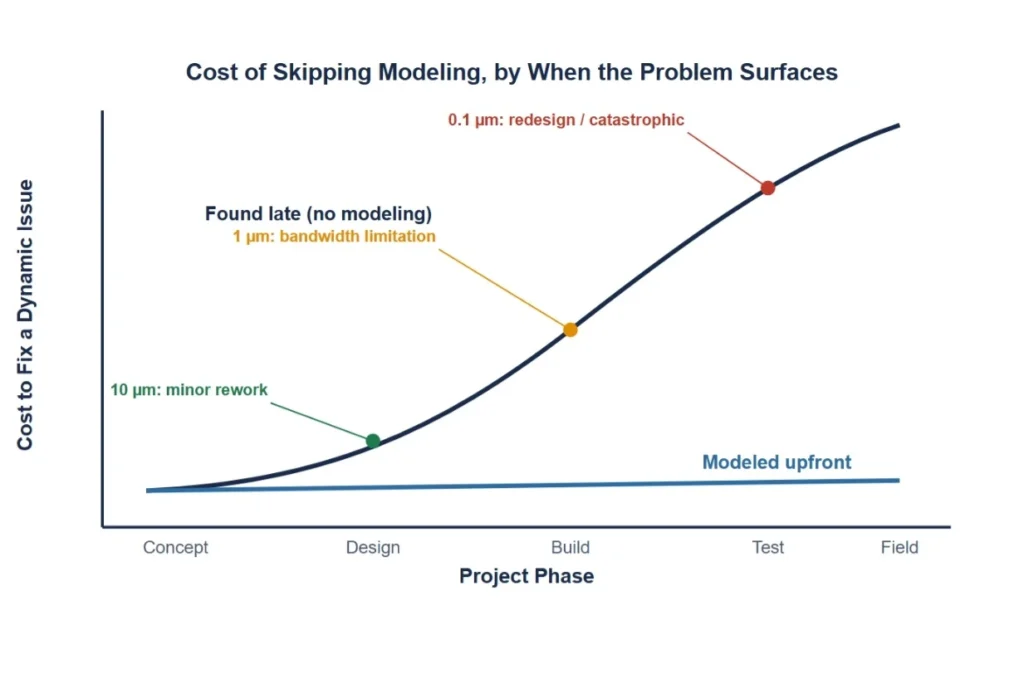
The Cost Curve of Skipping Modeling
Skipping modeling is always cheaper on day one. No simulation license, no modal analysis, no control-loop tuning on paper, just design, build, test.
But the cost doesn’t disappear, it moves downstream: a stage that rings under acceleration, a control loop that can’t be tuned past a certain bandwidth. The later a dynamic problem is found, the more expensive it is to fix, often by an order of magnitude between a simulation cost and a redesign after prototype testing.
Technology Comparison at a Glance
| Precision target | Typical application | Minimum modeling we apply | Main risk if skipped |
| ~10µm Low acceleration | Generic mechatronics Low productivity systems | Hand calculations (stiffness, load, deflection); static FEA as a sanity check | Oversized or undersized structure, minor rework |
| ~1 µm | General precision positioning | Static FEA and modal (eigenfrequency) analysis | An unseen structural mode falls inside or near the control bandwidth, causing poor settling or large floor noise transmission |
| ~0.1 µm | Ultra precision Semiconductor Metrology | Full dynamic modeling: MATLAB/Simulink, control-loop simulation, floor vibration and isolator coupling, thermal drift | Cross-coupled disturbances that no single analysis would catch, often unrecoverable without a redesign |
What Each Level Actually Involves
10 µm class — hand calculations.
At this level, physics is forgiving. A quick stiffness and deflection calculation, checked against a static FEA run, is usually enough to confirm the structure won’t visibly bend or wobble under load. Dynamics rarely matter because the required bandwidth is low and the tolerances are generous relative to structural noise.
1 µm class — modal analysis becomes mandatory.
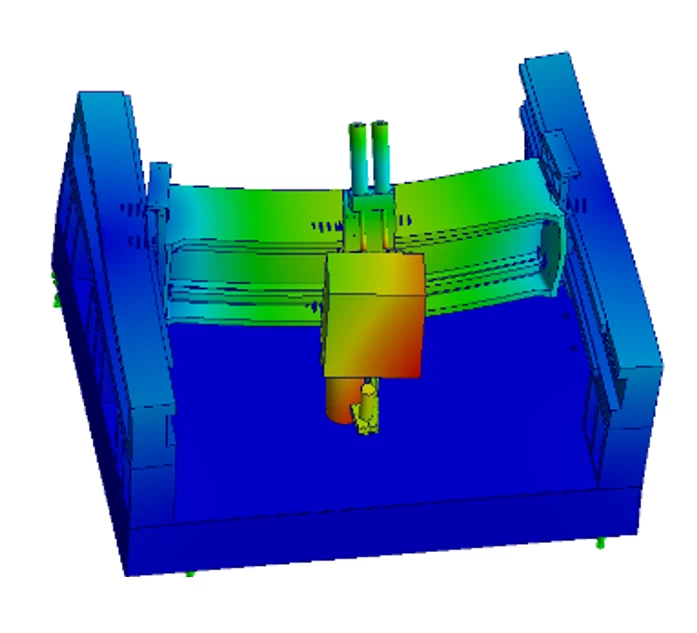
Static FEA alone is no longer sufficient. The structure now needs a modal (eigenfrequency) analysis to locate its resonant modes. The critical check: no significant mode should sit near or below the control bandwidth.
Many engineers skip this step, as they either do not know how to perform a modal analysis or interpret the results, other think they can get away without it, lettting the “experience” talk, and some simply do not want to spend the time or money to invest in such software.
This is the point where “it looked fine on paper” and “it looked fine in FEA” start to diverge. A soft mode there will fight the servo loop, limiting achievable bandwidth or causing outright oscillation.
0.1 µm class — full dynamic system modeling.
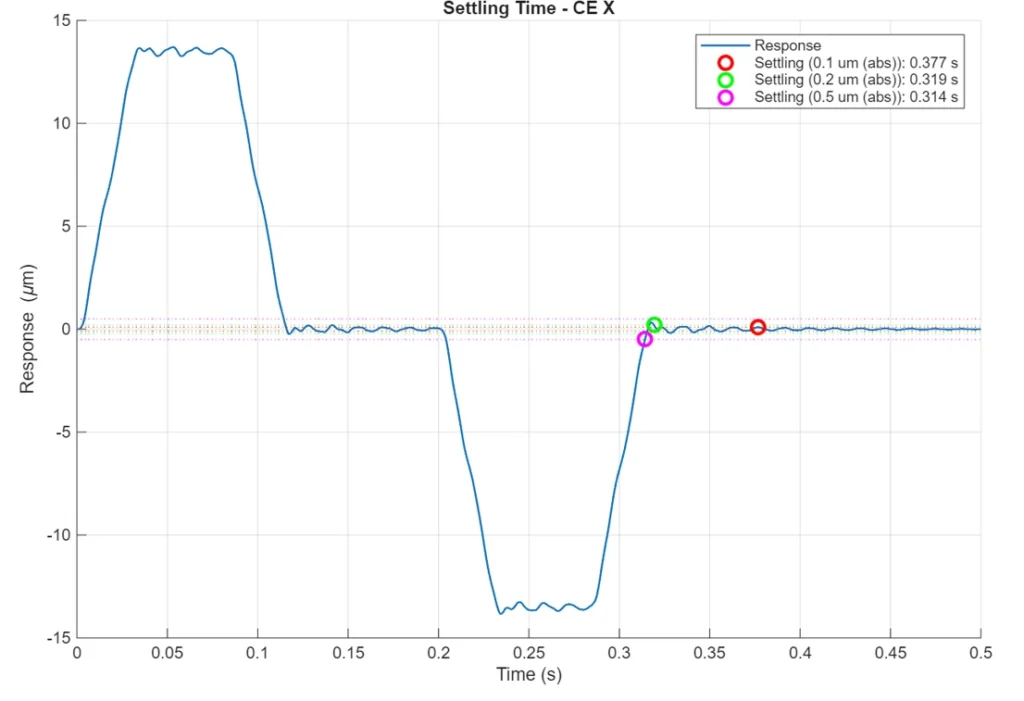
Here, no single tool or analysis is enough. The mechanical structure, control loops, actuator dynamics, sensor noise, floor vibration, and vibration isolators all interact, and none of them can be modeled in isolation. Engineers build coupled models in MATLAB/Simulink (or equivalent), simulate the closed-loop behavior end-to-end, and stress-test it against real disturbance sources before a single part is machined.
At this precision, a missed interaction, a resonance excited by the isolator, a sensor noise floor amplified by the loop gain, isn’t a nuisance, it’s often catastrophic to the program.
Choosing the Right Level
- Don’t over-model a 10 µm stage. Full dynamic simulation on a low-precision, low-bandwidth system burns budget without changing the outcome.
- Don’t under-model a 1 µm stage. Skipping modal analysis to save a a few weeks is the single most common root cause of late-stage bandwidth and performance problems.
- Never guess at 0.1 µm. Below this threshold, intuition and hand calculations reliably miss the interactions that actually limit performance. Designing at that level of precision without preliminary modeling is like tossing a coin.
Conclusion
Modeling depth should scale with precision and dynamics, not with habit or schedule pressure.
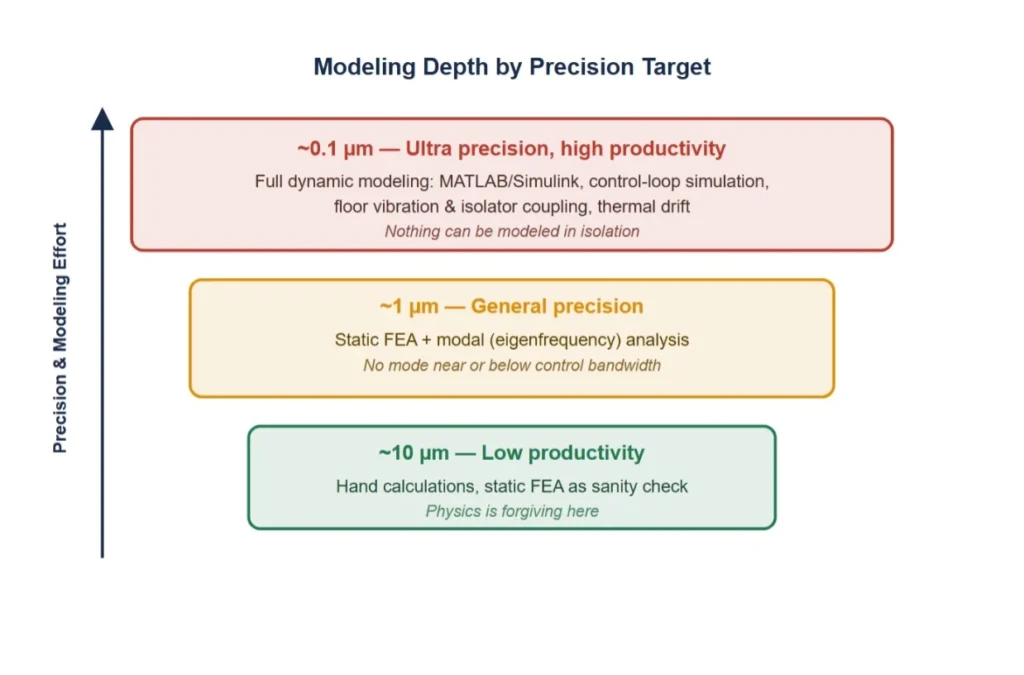
- 10 µm → hand calculations, static FEA as backup.
- 1 µm → static FEA plus mandatory modal analysis to clear the control bandwidth.
- 0.1 µm → full multi-domain dynamic modeling, from structure to control loop to floor vibration.
Skipping the right level of modeling doesn’t remove the risk: it just defers it to the moment it becomes most expensive to fix.